Introduction
Clients are the core functionality that the korapay_client package provides. They are
python classes that provide methods that perform the low level REST API calls to
Korapay hence providing these methods as a simpler interface
for interacting with Korapay in your python project. Each methods
on the clients has a one to one mapping to the REST endpoints from
Korapay's REST API Reference. E.g., KorapayClient.charge_via_card
maps to https://api.korapay.com/merchant/api/v1/charges/card
korapay_client provides two client variants for interfacing with Korapay.
I.e., KorapayClient a synchronous client and AsyncKorapayClient an asynchronous client. a
non-blocking copy of the KorapayClient useful in an asynchronous context. AsyncKorapayClient
methods fully mirrors methods on the KorapayClient except that the methods on the AsyncKorapayClient
are awaitable.
All the methods of a client abstracting low level REST calls to Korapay have the
same return type a Response which is a pydantic model containing the status_code, status, message
and data fields representing the response returned by Korapay
Instantiating clients
The two variants of clients provided by the korapay_client package can be instantiated by passing the credentials
directly on class instantiation or by setting these credentials in your project's environmental variables. Credentials
provided on class instantiation are prioritized over credentials provided in the environmental variables. i.e., If you
have your korapay integration secret key set in your project's environmental variables, and you also provide a secret
key when instantiating the client classes, the clients will use the secret key you provided while instantiating the
client class.
Where can I find my Korapay credentials?
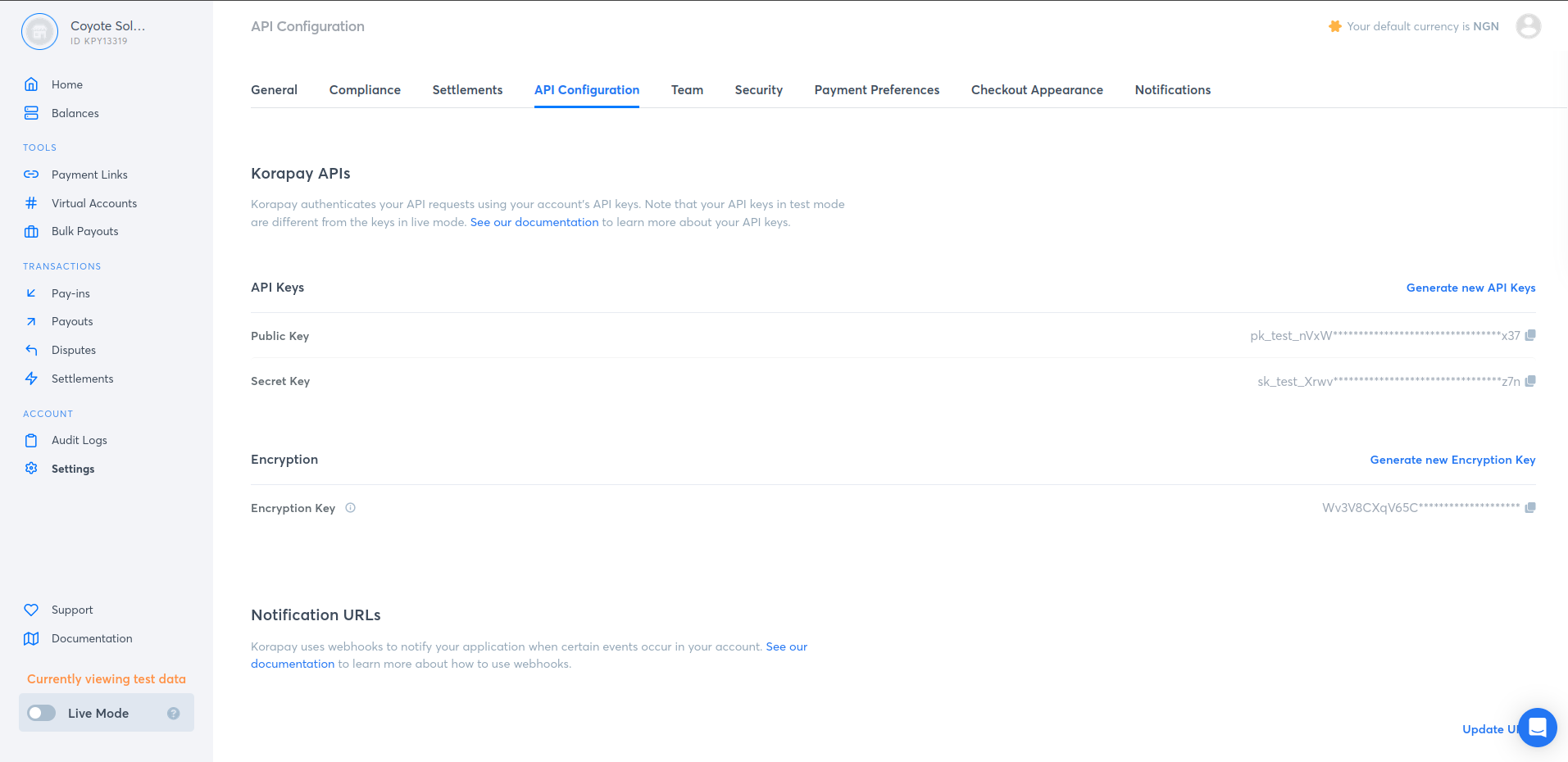
Your korapay credentials like your public key, secret key and encryption are available to you after creating an account with Korapay. Log in to your korapay dashbord, in your settings page, go to the API Configuration tab. click on the image below to zoom.
Danger
Providing your credentials to the clients on class instantiation is highly discouraged as your credentials are sensitive. The preferred way of providing your Korapay credentials to the client is via your project's environmental variables.
Instantiating clients by passing credentials directly on class instantiation
from korapay_client import KorapayClient, AsyncKorapayClient

sync_client = KorapayClient(
    public_key="<your-public-key>",
    secret_key="<your-secret-key>",
    encryption_key="<your-encryption-key>")

async_client = AsyncKorapayClient(
    public_key="<your-public-key>",
    secret_key="<your-secret-key>",
    encryption_key="<your-encryption-key>")
Instantiating clients by providing credentials in your environmental variables
export KORAPAY_PUBLIC_KEY=<your-public-key>
export KORAPAY_SECRET_KEY=<your-secret-key>
export KORAPAY_ENCRYPTION_KEY=<your-encryption-key>
from korapay_client import KorapayClient, AsyncKorapayClient

sync_client = KorapayClient()

async_client = AsyncKorapayClient()
Note
korapay_client requires you to provide your public key, secret key and encryption key even though it
doesn't really use your public key and only uses your encryption key while process requests for card
payments.